Why Some Gas Stations Suddenly Close Without Notice
In the volatile economic landscape of April 2026, many Nigerians have pulled up to their regular filling station only to find the gates locked and the pumps silent. With the price of petrol at ₦1,200 per liter, these sudden closures have become a source of frustration for commuters and a signal of deep-seated shifts in the energy market.
A station that was serving hundreds of cars on a Tuesday morning may be completely dark by Tuesday afternoon. While it may seem like a simple case of “running out of gas,” the reasons behind these sudden disappearances are often far more complex, involving massive financial risks, regulatory crackdowns, and a cutthroat battle for supply.
For the independent marketer, the era of ₦1,200 petrol has turned a once-stable business into a high stakes gamble. The “invisible” forces ranging from the high cost of bank loans to the shifting strategies of major refineries are the true drivers behind these closures.
Understanding why a station suddenly shuts its doors is essential for navigating the modern Nigerian economy, where energy availability is no longer guaranteed by the government but is dictated by the harsh realities of a deregulated market.
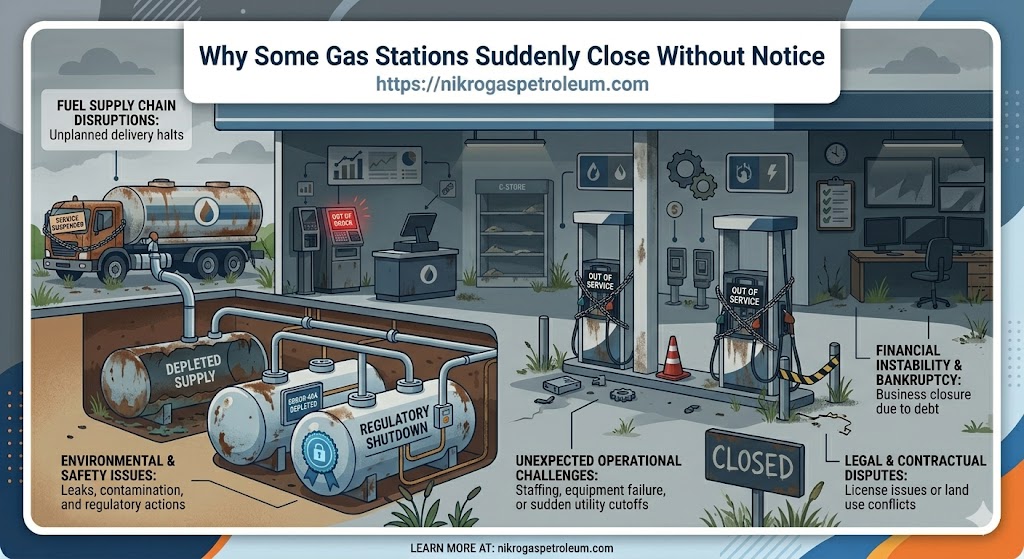
Why Some Gas Stations Suddenly Close Without Notice
The Financial Strain of High Value Inventory
The primary reason for sudden closures in 2026 is “Capital Squeeze.” To fill a standard 45,000-liter tanker in the current market, a station owner now needs approximately ₦54 million in liquid cash. Just a few years ago, that same truckload cost less than ₦10 million.
Many independent marketers do not have this kind of cash sitting in their accounts. They rely on bank loans, and with interest rates at record highs, the “dividends” or profits are often too low to cover the interest payments.
When a station manager sees the price at the depot jump by another ₦50 overnight, they may realize that selling their current stock at the old price will not provide enough money to buy the next truckload.
This is known as a “replacement cost” crisis. To avoid losing their capital, they may suddenly close the station to “hoard” or save their remaining fuel until the market price stabilizes or until they can secure more funding.
Why Gas Stations Shut Down Abruptly
| Closure Reason | Type of Impact | Primary Driver |
| Capital Squeeze | Financial | High cost of ₦54m+ per truckload |
| Depot Price Hikes | Supply Chain | Sudden jumps in ex-depot costs |
| Regulatory Clampdown | Legal | Safety violations or illegal siting |
| Strategic Supply Shift | Market Power | Refineries favoring major marketers |
| Hoarding for Gains | Speculative | Anticipating a ₦100+ price hike |
The “Big Marketer” vs. “Independent” Divide
A major shift occurred in early 2026 when large refineries, including the Dangote Petroleum Refinery, began streamlining their distribution. In many cases, supply was restricted to a “consortium” of roughly 20 major marketers, effectively sidelining thousands of smaller, independent operators. These smaller stations suddenly found themselves without a direct source of fuel. When their existing tanks run dry, they cannot simply call for a refill. They must wait in line behind the “big players” or buy from third-party depots at a much higher price. If the numbers don’t add up, the station simply shuts its gates.
Regulatory and Safety Enforcement
Not all closures are financial. The Nigerian Midstream and Downstream Petroleum Regulatory Authority (NMDPRA) has intensified its enforcement of safety and environmental standards. As urban areas expand, many gas stations that were once on the outskirts are now surrounded by homes, schools, and markets. In April 2026, authorities have been shutting down dozens of “high-risk” stations that fail to maintain a 30-meter setback from residential buildings. These closures happen “without notice” to prevent operators from hiding safety violations or tampering with meters before the inspectors arrive.
Types of Closures and What They Mean
There are three distinct categories of station closures that consumers should be aware of.
The “Supply Suspension”
This is the most common type of closure. The station is still in business, but its tanks are empty. In 2026, transporters face significant risks, including poor road conditions and security threats, which can delay a fuel truck for days. When a station closes because of a delay, it is usually temporary. You can often see the “No Fuel” sign or the hoses wrapped around the pumps.
The “Price Adjustment” Pause
When the global price of Brent crude spikes (as it did recently toward $100 per barrel due to Middle East tensions), Nigerian marketers must recalculate their pump prices. Some stations shut down for 2 to 4 hours in the middle of the day to re-calibrate their digital pumps and signage. They close the gates briefly to avoid a “stampede” of drivers trying to buy fuel at the old price before the update is complete.
The “Permanent Exit”
With petrol at ₦1,200, the “mom-and-pop” gas station is becoming a relic of the past. Many owners are realizing that the cost of electricity (to run pumps and lights), security, and labor is higher than the ₦20 or ₦30 profit margin per liter. These stations close without notice because the owner has simply decided to sell the land for more profitable real estate developments, like shopping malls or apartments.
How to Apply Better Fuel Planning Strategies
While you cannot stop a station from closing, you can apply several strategies to ensure you are never stranded with an empty tank.
Use Real-Time Market Monitoring
In 2026, several mobile apps and social media groups provide real-time updates on which stations in Lagos, Abuja, or Port Harcourt are open and selling at the ₦1,200 mark. Applying a “check-before-you-drive” habit can save you the wasted fuel of driving to three different closed stations.
Avoid the “Quarter-Tank” Rule
In the past, drivers were told to refuel when they hit a quarter-tank. With ₦1,200 petrol and sudden closures, you should apply a “Half-Tank” rule. If you see a reputable major marketer (like TotalEnergies or NNPC Retail) open and the queue is short, refuel then—even if you have half a tank. The next three stations on your route might be closed or selling at ₦1,300.
Apply for Corporate Fuel Cards
Many major marketing companies offer fuel cards that guarantee you a certain volume of fuel or priority access during “scarcity” events. Applying for these cards as a business or even an individual ensures that you are part of a tracked loyalty program. Stations are less likely to “turn away” cardholders even when they are nearing their last 5,000 liters of stock.
Frequently Asked Questions (FAQ)
Is it legal for a station to close just because they want to hike the price?
Strictly speaking, “hoarding” is illegal under NMDPRA regulations. However, marketers argue that if they sell at the old price when the new depot price is higher, they will not be able to “replace” their stock. This creates a gray area where stations “close for maintenance” while waiting for the price change to become official.
Why are some stations open but only using one pump?
This is often a tactic to manage “power costs.” Running all eight pumps on a large generator is expensive. With fuel at ₦1,200, the station may limit sales to one or two pumps to save on electricity and to make their remaining stock last longer throughout the day.
How do I know if a station is closed permanently or just out of stock?
Look at the forecourt. If the convenience store is still open and staff are visible but the gates are closed to cars, they are likely just waiting for a tanker. If the station looks overgrown, the signage is removed, or there are no staff present for several days, it is likely a permanent closure.
Why do stations close when there is a rumor of a protest?
Security is the biggest concern. A gas station holding ₦54 million worth of fuel and high-value convenience store stock is a prime target during civil unrest. Managers will close without notice at the first sign of trouble to protect their staff and property.
Also Read: Why Gas Prices Keep Fluctuating Yearly
Also Read: Common Mistakes People Make at Gas Stations
Also Read: Are Electric Vehicles Killing Gas Stations
Conclusion
The sudden closure of a gas station in 2026 is rarely an accident; it is a calculated response to a high pressure economic environment. Between the ₦1,200 per liter price tag, the ₦54 million cost of a single tanker, and the strict safety enforcement by the NMDPRA, station owners are walking a financial tightrope. While the transition to a deregulated market promises better efficiency in the long run, the current “growing pains” mean that consumers must be more proactive than ever.
By understanding the “why” behind these closures whether it is capital strain or regulatory action, you can better plan your movements and protect your budget. In this new era of Nigerian energy, the most valuable asset isn’t just the fuel in your tank, but the information you use to find it. Stay alert, plan ahead, and always keep an eye on the “Market Dynamics” that dictate whether those station gates stay open or shut.