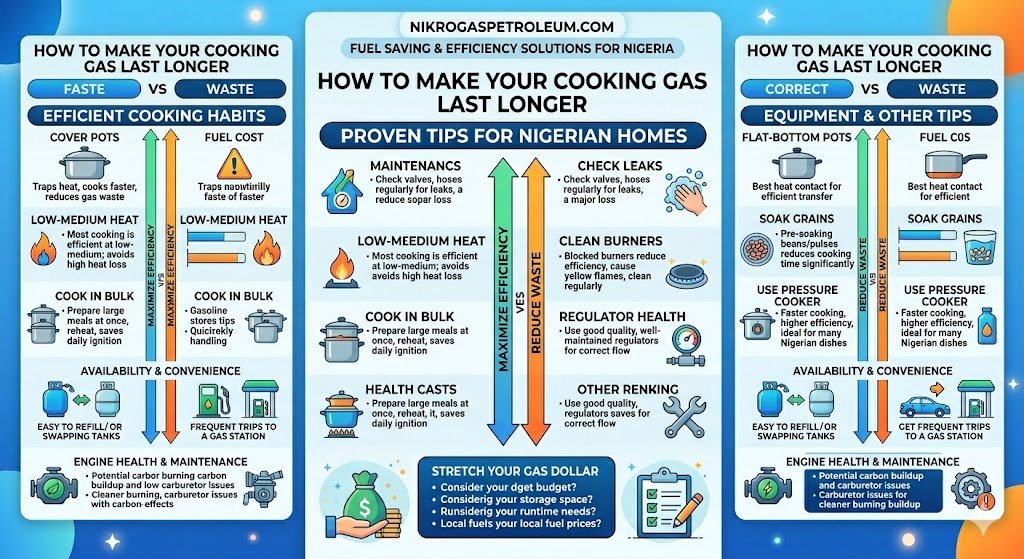
How to Make Your Cooking Gas Last Longer (Proven Tips for Nigerian Homes)
In the current Nigerian economy of April 2026, managing household expenses has become a specialized skill. With the price of Liquefied Petroleum Gas (LPG) reaching ₦1,200 per kilogram, a standard 12.5kg cylinder now costs ₦15,000 to refill. For many families, this is a significant portion of the monthly budget.
Learning how to make your cooking gas last longer is no longer just about being “frugal”; it is a necessary financial strategy to survive high inflation. Whether you are using gas for a small family or running a busy kitchen, small adjustments in your cooking habits can extend the life of your cylinder by two to three weeks.
The efficiency of cooking gas is often lost through poor heat management, substandard cookware, and lack of maintenance. In a high value energy market, every blue flame that escapes around the side of a pot is money disappearing into thin air.
By applying scientifically proven kitchen habits and maintaining your equipment, you can reduce your gas consumption by up to 30%. This article provides a comprehensive guide to mastering gas efficiency in a Nigerian home.
The Science of Gas Consumption and Heat Loss
To save gas, you must understand how it burns. LPG requires a specific mixture of oxygen to create the “perfect blue flame.” When your burner produces a yellow or orange flame, it is a sign of incomplete combustion, meaning you are wasting gas and blackening your pots. A yellow flame is significantly cooler than a blue flame, which means you have to leave the gas on longer to achieve the same cooking temperature.
Furthermore, heat loss is the biggest enemy of your 12.5kg cylinder. When you cook in an open pot or use a burner that is wider than the base of your pot, the heat escapes into the kitchen instead of entering the food. In 2026, with gas at ₦1,200 per kg, the goal is to trap every single thermal unit inside the cooking vessel.
How to Make Your Cooking Gas Last Longer (Proven Tips for Nigerian Homes)
Impact of Cooking Habits on Gas Longevity
| Cooking Habit | Estimated Gas Saved | Monthly Savings (₦) |
| Using a Pressure Cooker | 50% – 70% | ₦4,500 – ₦6,000 |
| Covering All Pots | 15% – 20% | ₦1,800 – ₦2,400 |
| Soaking Hard Grains | 25% – 30% | ₦2,500 – ₦3,500 |
| Using Right Burner Size | 10% | ₦1,200 |
| Cleaning Burner Heads | 5% – 10% | ₦600 – ₦1,200 |
The Power of the Pressure Cooker
In 2026, the pressure cooker has become the most valuable tool in the Nigerian kitchen. For foods that take a long time to soften, such as beans, tough meat, or brown rice, a pressure cooker can reduce cooking time from 90 minutes to just 30 minutes. Since the pot is airtight, it builds up steam pressure that cooks food at a much higher temperature than boiling water. Applying this one tool alone can make a 12.5kg cylinder last an extra month for a heavy-cooking household.
Pre-Cooking Preparation (Mise en Place)
One of the most common mistakes people make is lighting the gas before they are ready to cook. If you turn on the burner and then start peeling onions or looking for salt, you are burning ₦1,200 per kg gas for no reason. Professional chefs use a technique called “Mise en Place,” which means “everything in its place.” Have your water measured, your vegetables chopped, and your spices ready before you strike the match. This ensures that the gas is only running when there is actual cooking happening.
Types of Cookware That Save Gas
Not all pots are created equal when it comes to energy efficiency. The material and shape of your cookware play a massive role in how much gas you use.
Stainless Steel vs. Aluminum
Aluminum pots are common in Nigeria (the famous “iron pots”), and they are excellent conductors of heat. However, stainless steel pots with a copper or aluminum base are even better at retaining heat. Once a high-quality stainless steel pot gets hot, it stays hot, allowing you to turn the gas down to a “simmer” while still maintaining a boil.
Flat-Bottomed Pots
Ensure your pots have a perfectly flat bottom. If a pot is dented or curved, it does not make full contact with the grate, and the heat distribution becomes uneven. This causes the food to take longer to cook, wasting precious gas. In 2026, it is worth investing in a new set of flat-bottomed cookware if your old pots are warped.
How to Apply Gas Saving Techniques for Traditional Dishes
Nigerian cuisine involves many “long boil” dishes. Here is how to apply gas-saving logic to our favorite meals.
The “Soaking” Method for Beans and Grains
Hard grains like beans and local rice consume the most gas. To save money, soak your beans in water for at least 4 to 6 hours (or overnight) before cooking. This softens the outer shell and starts the rehydration process. Soaked beans cook up to 40% faster than dry beans. Additionally, adding a tiny pinch of baking soda can further reduce the softening time, though some prefer the natural method.
Parboiling with Retained Heat
When cooking rice or pasta, you don’t need to keep the gas on high until the food is completely soft. Once the water reaches a rolling boil and the rice has cooked for about 5 to 10 minutes, you can turn off the gas entirely, keep the lid tightly shut, and let the “retained heat” finish the job. The steam trapped inside the pot will continue to cook the rice for another 15 minutes without using a single drop of gas.
Batch Cooking and Warming
Avoid cooking small meals multiple times a day. It takes a lot of gas just to bring a pot of water to a boil. Instead, cook large batches of stews, soups, and grains over the weekend. Store them in the fridge or freezer and use a microwave or a very brief “steam” on the gas cooker to warm only what you need. Warming food takes 90% less gas than cooking it from scratch.
Maintenance Tips to Prevent Gas Waste
A poorly maintained gas cooker is a silent thief of your ₦15,000 refill.
Cleaning the Burner Ports
Over time, food spills and grease clog the tiny holes in your burner head. This restricts the flow of gas and causes the flame to turn yellow. Once a week, remove the burner heads and soak them in warm soapy water. Use a small needle or a stiff brush to clear the holes. A clean burner provides a sharp, blue flame that cooks faster and uses less gas.
Checking for Micro-Leaks
Small leaks at the regulator or along the hose are not only dangerous but also expensive. Even a tiny leak can drain a few grams of gas every hour, 24 hours a day. Apply soapy water to the hose and the regulator connections once a month. If you see bubbles forming, you have a leak. Replacing a worn-out hose or a faulty regulator is much cheaper than wasting gas at ₦1,200 per kg.
Frequently Asked Questions (FAQ)
Does cooking on a low flame really save gas?
Yes and no. The most efficient flame is one that is medium high but does not “lick” the sides of the pot. If the flame is wider than the pot, you are wasting energy. If the flame is too low, the cooking time becomes excessively long, which can sometimes lead to more gas usage overall. Aim for a flame that stays directly under the base of the pot.
Is it better to cook with a lid on or off?
Always cook with a lid on. Cooking without a lid allows steam and heat to escape, increasing cooking time by up to 30%. A lid traps the steam, creating a mini-pressure environment that speeds up the process.
Why does my gas finish faster during the rainy season?
In the rainy or cold season, the ambient temperature of your water and food is lower. It takes more energy (gas) to bring cold water to a boil than it does during the hot season. You can mitigate this by keeping your water in a thermos or a room-temperature container instead of using chilled water from the tap or fridge.
Does the size of the gas cylinder affect how long the gas lasts?
The size of the cylinder (3kg, 6kg, 12.5kg, or 50kg) doesn’t change the efficiency, but larger cylinders are often slightly cheaper per kilogram at the gas plant. If you can afford the upfront cost, refilling a 50kg cylinder often provides a “bulk discount” compared to refilling a 6kg cylinder multiple times.
Also Read: Are Electric Vehicles Killing Gas Stations
Also Read: Jobs in Germany And United Kingdom for Foreigners
Conclusion
Managing cooking gas in 2026 is an exercise in mindfulness and discipline. With the price at ₦1,200 per kg, the “old ways” of cooking with open pots and unsoaked beans are simply too expensive. By adopting the use of pressure cookers, practicing the “Mise en Place” preparation method, and maintaining your burner heads, you can significantly extend the life of your 12.5kg cylinder.
These tips don’t just save you money; they also reduce your time in the kitchen, giving you more freedom to focus on other parts of your life. In a high cost environment, the most successful homes are those that apply technical knowledge to everyday tasks. Start applying these changes today, and watch your gas and your money last longer than ever before.