Are Electric Vehicles Killing Gas Stations
The global automotive landscape is undergoing a massive transformation as the adoption of electric vehicles (EVs) accelerates in 2026. This shift has raised a critical question for economists, business owners, and consumers: Are electric vehicles killing gas stations? While the rise of Tesla, BYD, and other EV manufacturers is undeniable, the reality is more about evolution than immediate extinction.
In Nigeria, where the price of petrol has reached ₦1,200 per liter as of April 2026, the conversation around the survival of traditional fuel retail is becoming more urgent than ever. High value markets are now looking at how energy distribution must pivot to remain profitable.
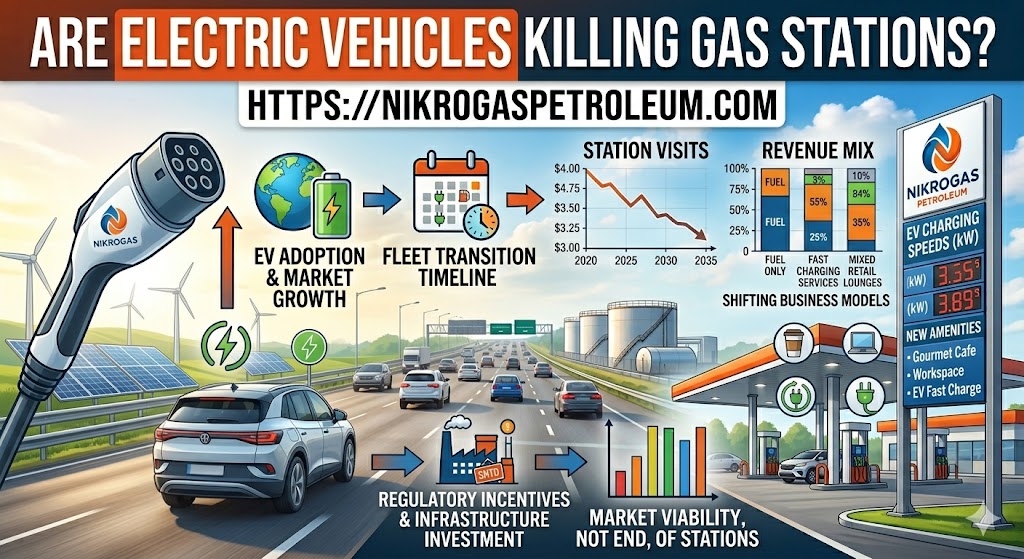
The threat to gas stations is real but varies significantly by region. In EV dominant markets, fuel retail profits are projected to decline by as much as 60% by the end of the decade. However, gas stations are not just fuel points; they are strategic retail hubs.
The stations that survive are those transforming into “Energy Hubs” that cater to both internal combustion engines (ICE) and battery electric vehicles. With the global EV charging value pool expected to reach over $150 billion by 2030, the opportunity for gas stations to diversify is massive.
Are Electric Vehicles Killing Gas Stations?
The Economic Impact of EVs on Traditional Fuel Retail
The traditional business model of a gas station relies on low margins from fuel sales and high margins from convenience store purchases. As EV owners charge their vehicles at home, they bypass the station entirely. This “at home” charging advantage is the biggest disruptor to the industry.
However, for long distance travel and urban dwellers without home charging access, public stations remain a necessity. In 2026, we are seeing a clear divide between stations that are closing and those that are thriving through modernization.
Statistics show that while thousands of smaller, fuel only stations are shutting down, larger convenience store chains like 7-Eleven are investing heavily in ultra fast charging infrastructure.
By providing 350 kW+ chargers that can give a vehicle 80% charge in just 15 minutes, these stations are recapturing the “dwell time” of drivers. An EV owner spends an average of 20 minutes at a station compared to 5 minutes for a gas car driver, and data shows they spend roughly 25% more on food and snacks during that wait.
Comparing Gas Stations vs EV Charging Hubs
| Feature | Gas Station (ICE) | EV Charging Hub |
| Fueling Time | 3 – 7 Minutes | 15 – 40 Minutes |
| Avg Spend ₦ | ₦20,000 – ₦60,000 | ₦8,000 – ₦15,000 |
| Retail Profit | Moderate | Very High |
| Infrastructure | Underground Tanks | Grid Transformers |
| Maintenance | High (Leaks/Safety) | Moderate (Software) |
The Rise of Ultra Fast Charging and Next Gen Batteries
One of the biggest factors preventing EVs from completely killing gas stations is the current limitation of charging speed. However, 2026 has seen the mainstreaming of solid state batteries and ultra fast chargers. These technologies aim to bring the charging experience closer to the speed of a traditional fuel pump. For gas station owners, installing these high tech chargers is a high capital investment, often costing upwards of $100,000 per unit. But in a market where petrol is ₦1,200, the demand for cheaper, electricity based mobility is driving a rapid return on investment for these “Energy Hubs.”
Urbanization and the No Home Charging Barrier
A significant portion of the population lives in high rise apartments or rented accommodation without dedicated parking. For these individuals, gas stations—or their evolved versions—are the only reliable way to power their vehicles. In cities like Lagos or Abuja, the infrastructure for home charging is still in its infancy. This creates a “safety net” for gas stations, as they remain the primary source of energy for the millions of drivers who cannot charge overnight. The stations that pivot to provide reliable, fast, and safe charging environments will capture this entire market segment.
Types of Stations Evolving in 2026
The industry is currently splitting into three distinct types of energy providers.
The Traditional Fuel Station
These are located mostly in rural areas or along less traveled routes. They focus almost exclusively on petrol and diesel. While they are safe for now, they face the highest risk of closure as the used EV market grows. By 2026, electrified vehicles represent 8% of the total used car inventory, a number that is doubling every two years.
The Hybrid Energy Center
These are the most successful stations in 2026. They offer petrol, diesel, and multiple EV charging ports. They have expanded their seating areas, added high speed Wi-Fi, and improved their food offerings to cater to the longer dwell times of EV drivers. This model balances the high volume of gas cars with the high margin retail spending of EV owners.
The Pure EV Charging Plaza
Located primarily in high income urban centers, these locations have removed fuel pumps entirely. They often feature luxury lounges, cafes, and even small co-working spaces. Because they don’t have to deal with the environmental hazards of underground fuel tanks, they can be built in more prime real estate locations where traditional gas stations are banned.
How to Apply for EV Charging Station Partnerships
If you are a land owner or a gas station operator in Nigeria, applying to become a charging partner is a strategic move to future proof your business.
Identify Your Power Capacity
The first step in the application process is a technical audit of your location’s proximity to high voltage power lines. EV chargers require a significant “draw” from the grid. If your location is near an industrial zone or a major transformer, your application to charging networks like Tesla (Superchargers) or local Nigerian providers will be prioritized.
Choose a Business Model
You can apply as a “Host” where a charging company pays you rent to place their chargers on your land, or as an “Owner-Operator” where you buy the equipment and keep all the profit from the ₦ per kWh fees. In 2026, the “Charging-as-a-Service” (CaaS) model is becoming popular, where you pay a monthly fee for the equipment and maintenance while sharing the revenue.
Secure Regulatory Approval
In Nigeria, you must ensure your station complies with the Nigerian Electricity Regulatory Commission (NERC) guidelines and fire safety standards. Applying for these permits early is crucial, as the demand for “green energy” licenses has spiked along with the ₦1,200 fuel prices.
Frequently Asked Questions (FAQ)
Are gas stations going to disappear completely?
No, but their numbers will shrink. It is estimated that 25% of existing fuel stations could close by 2035 if they do not add charging or retail value. The stations in high traffic areas will likely survive by becoming multi energy hubs.
Is it cheaper to charge an EV than to buy ₦1,200 petrol?
Yes, significantly. Even with rising electricity tariffs in 2026, the cost to drive an electric vehicle the same distance as a petrol car is roughly 70% cheaper. This massive price gap is the primary reason why consumers are switching despite the higher upfront cost of EVs.
Can I charge my EV at a normal gas station?
Only if that station has installed specific EV charging hardware. You cannot plug a car into a standard wall outlet at a gas station and expect a fast charge. Look for the “EV” signage or use mobile apps to find stations that have upgraded their infrastructure.
What happens to the old underground gas tanks?
When a gas station closes or converts to a pure EV plaza, the underground tanks must be professionally removed to prevent soil contamination. This is an expensive process, which is why many owners prefer to keep at least one or two fuel pumps while they transition to electric.
Also Read: Why Gas Prices Keep Fluctuating Yearly
Also Read: Common Mistakes People Make at Gas Stations
Also Read: Are Electric Vehicles Killing Gas Stations
Conclusion
Electric vehicles are not “killing” gas stations; they are forcing them to adapt or die. The “death” is only for those who refuse to see the shift in consumer behavior. With petrol at ₦1,200 per liter, the economic incentive to move toward electricity is too strong to ignore. The gas station of the future is a place where you might grab a coffee, answer emails, and charge your battery—all while your car’s software updates. By 2026, the winners in this industry are those who realize they are no longer in the “oil business” but in the “energy and hospitality business.” Adapting to this reality is the only way to stay relevant in an increasingly electrified world.