
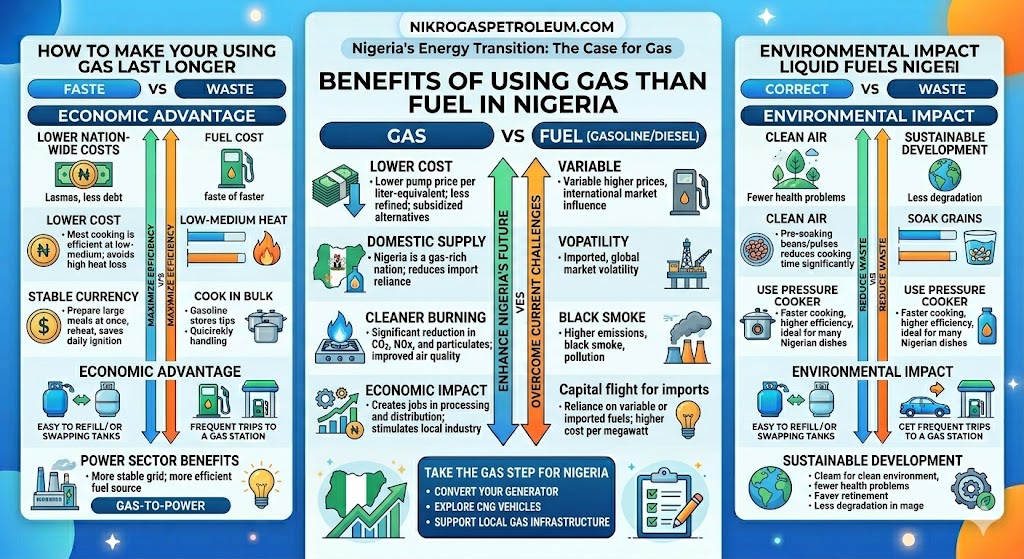
Benefits Of Using Gas Than Fuel In Nigeria
The energy landscape in Nigeria has reached a historic turning point in April 2026. With the total deregulation of the petroleum sector and the removal of all subsidies, the daily cost of living has become tethered to the efficiency of our fuel choices. Currently, petrol (fuel) is selling for ₦1,350 per liter, while Liquefied Petroleum Gas (LPG) is priced at ₦1,200 per kilogram.
This price gap is driving a massive migration from liquid fuels to gas for both domestic and industrial use. For the average Nigerian household, switching to gas is no longer just a modern preference; it is the most effective way to combat the high cost of energy.
The benefits of using gas over fuel extend far beyond the immediate savings at the point of purchase. From the longevity of your engine to the environmental impact and the sheer volume of “runtime” per unit, gas is outperforming petrol in almost every metric.
In a high value market where every Naira must be accounted for, understanding why gas is the superior energy source is essential for financial stability. This article provides an in depth analysis of why making the switch to gas is the smartest move you can make in 2026.
Benefits Of Using Gas Than Fuel In Nigeria
The Economic Efficiency of Gas Consumption
To appreciate the benefits, one must look at the “Energy Density” and consumption rates. A common misconception is comparing one liter of petrol to one kilogram of gas directly by price. However, these two substances burn at very different rates.
When used in a 2.5kVA generator, a single liter of petrol typically lasts about 45 to 55 minutes under a moderate load. At ₦1,350 per liter, that is a high hourly burn rate. In contrast, one kilogram of LPG, priced at ₦1,200, can power that same generator for over two hours. This means that while the “unit” of gas costs less than a “unit” of petrol, it also provides twice the amount of energy. The mathematical advantage is undeniable, making gas the king of cost-effective power generation.
Energy Comparison: Petrol vs. Gas Performance
| Performance Metric | Petrol (Fuel) | Cooking Gas (LPG) |
| Current Price | ₦1,350 / Liter | ₦1,200 / Kilogram |
| Hourly Runtime (2.5kVA) | ~50 Minutes | ~130 Minutes |
| Monthly Cost (6hrs/day) | ₦291,600 | ₦97,200 |
| Engine Oil Life | 50 – 70 Hours | 100 – 150 Hours |
| Carbon Emissions | High (Black Soot) | Very Low (Clean Burn) |
Prolonging Engine and Cookware Lifespan
One of the most significant “hidden” benefits of using gas is the reduction in maintenance costs. Petrol is a “heavy” fuel that leaves behind carbon deposits, also known as soot, inside the combustion chamber of your generator. This soot clogs spark plugs and contaminates the engine oil, turning it black and thick very quickly.
Gas is a much cleaner fuel. Because it enters the engine as a vapor, it burns almost completely, leaving behind zero soot. Users who have switched to gas find that their engine oil remains clear and golden even after 100 hours of use.
Similarly, in the kitchen, cooking with gas prevents the “black bottom” on pots that is common with kerosene or charcoal, saving you the cost and labor of abrasive cleaning agents and extending the life of your cookware.
Environmental and Health Advantages
As Nigeria moves toward a greener economy in 2026, the environmental benefits of gas cannot be ignored. Petrol generators are a major source of noise and air pollution in residential areas. The “smoke” from a petrol engine contains high levels of carbon monoxide and nitrogen oxides, which are harmful when inhaled.
Gas generators run significantly quieter often reducing noise levels by up to 30%. More importantly, the emissions from gas are virtually colorless and odorless. Switching to gas reduces your household’s carbon footprint and minimizes the risk of respiratory issues caused by inhaling thick generator fumes in poorly ventilated spaces.
Types of Gas Systems Benefiting Nigerians
There are several ways Nigerians are applying gas technology to replace expensive ₦1,350 fuel.
Dual-Fuel Generator Technology
The most popular application is the dual-fuel carburetor. This device allows a standard petrol generator to run on LPG (cooking gas). It is a simple, non-destructive modification that provides the flexibility to switch between fuels. In the event of a gas scarcity, you can still use petrol, but as long as gas remains at ₦1,200 per kg, it remains the primary choice for savvy users.
Compressed Natural Gas (CNG) for Transport
For vehicle owners, the benefit of gas is even more dramatic. CNG is being heavily promoted by the government as a direct alternative to petrol for cars and interstate buses. CNG is even cheaper than LPG, often providing a 70% saving compared to the ₦1,350 petrol price. While the conversion of a car is more expensive than a generator, the “payback period” in 2026 is less than six months for an active driver.
How to Apply the Switch to Gas Safely
Transitioning from fuel to gas requires a disciplined approach to safety to ensure that the benefits are not overshadowed by accidents.
Quality Over Cheapness
With the rush to avoid ₦1,350 petrol, the market is filled with low-quality conversion kits. When applying a gas system to your generator, ensure you use a “Zero-Pressure” or “High-Flow” regulator. These are designed to shut off the gas flow automatically if the engine stops, preventing dangerous gas build-up.
Ventilation and Positioning
Always apply the “Outdoor Rule.” Never operate a gas-powered generator or keep a large gas cylinder in a confined space. Because gas is heavier than air, any leak will settle at floor level and can become an explosion hazard if it meets a spark. Keep your cylinder at least 3 to 5 meters away from the generator’s exhaust pipe using a high-pressure reinforced hose.
Regular Leak Audits
Apply a simple soapy water test to your gas connections every time you refill your cylinder. If you see bubbles, there is a leak. Unlike petrol, which you can see leaking on the floor, a gas leak is invisible. Staying proactive with these checks is the only way to enjoy the economic benefits of gas with total peace of mind.
Frequently Asked Questions (FAQ)
Is it true that gas can explode more easily than petrol?
Actually, gas systems in 2026 are highly regulated. Petrol is very volatile and a simple splash on a hot exhaust can cause a fire. Gas is contained in a pressurized steel cylinder that is much harder to puncture. As long as your hoses are in good condition and your connections are tight, gas is statistically as safe as petrol.
Can I use the same 12.5kg cylinder for cooking and my generator?
Yes, the gas is identical. However, many Nigerians find it beneficial to have a dedicated cylinder for the generator. This helps in tracking how much you are spending on “power” versus how much you are spending on “food,” making your monthly budgeting more accurate.
Why does my generator struggle to start on gas in the morning?
Gas requires a specific air-to-fuel ratio to ignite. In the cold mornings, the gas pressure inside the cylinder might be slightly lower. A simple tip is to start the generator on petrol for 2 minutes to warm up the engine, then switch it over to the gas line once the engine is stable.
Will the price of gas stay at ₦1,200?
While all energy prices are subject to global market shifts, Nigeria has vast natural gas reserves. The government is currently prioritizing “Gas to Power” initiatives, which suggests that gas will likely remain more price-stable and accessible than refined petrol in the long run.
Also Read: How to Make Your Cooking Gas Last Longer
Also Read: Are Electric Vehicles Killing Gas Stations
Also Read: Jobs in Germany And United Kingdom for Foreigners
Conclusion
The transition from fuel to gas is the most logical step for any Nigerian looking to survive the current economic pressures of April 2026. At ₦1,350 per liter, petrol has become a luxury that many businesses and households can no longer afford to use for hours on end. The shift to ₦1,200 per kg gas offers a cleaner, quieter, and significantly cheaper alternative that pays for itself through reduced maintenance and doubled runtimes.
By understanding the technical benefits and applying the necessary safety protocols, you can reclaim control over your energy costs. The age of petrol dominance is fading, and the age of gas is here to stay. Making the switch today is not just a trend, it is a vital financial strategy for a sustainable future.