Gas or Fuel: Which Is More Cheaper To Use for Your Generator?
In Nigeria’s current economic climate, the question of how to power our homes and businesses has moved from a simple choice to a critical financial strategy. As of April 2026, the cost of energy has reached unprecedented levels. With petrol (fuel) selling at ₦1,350 per liter and cooking gas (LPG) priced at ₦1,200 per kilogram, every hour of power generation counts.
For many, the “I pass my neighbor” and larger capacity generators are the only source of electricity, making the efficiency of your fuel choice a make or break factor for your monthly budget.
The debate over whether gas or fuel is cheaper is no longer just about the price at the pump or the gas plant; it is about the “burn rate.” While the price of fuel is technically higher per unit, the way a generator engine consumes these two different energy sources determines the true winner.
High value energy management in 2026 demands a deep dive into these numbers to protect your disposable income.
Gas or Fuel: Which Is More Cheaper To Use for Your Generator?
The Economic Breakdown: Petrol vs. Gas Costs
To determine the most cost-effective option, we must look at how much a standard generator consumes under a typical load. In 2026, the price gap between the two is narrow on the surface, but the chemical efficiency of gas provides a massive advantage.
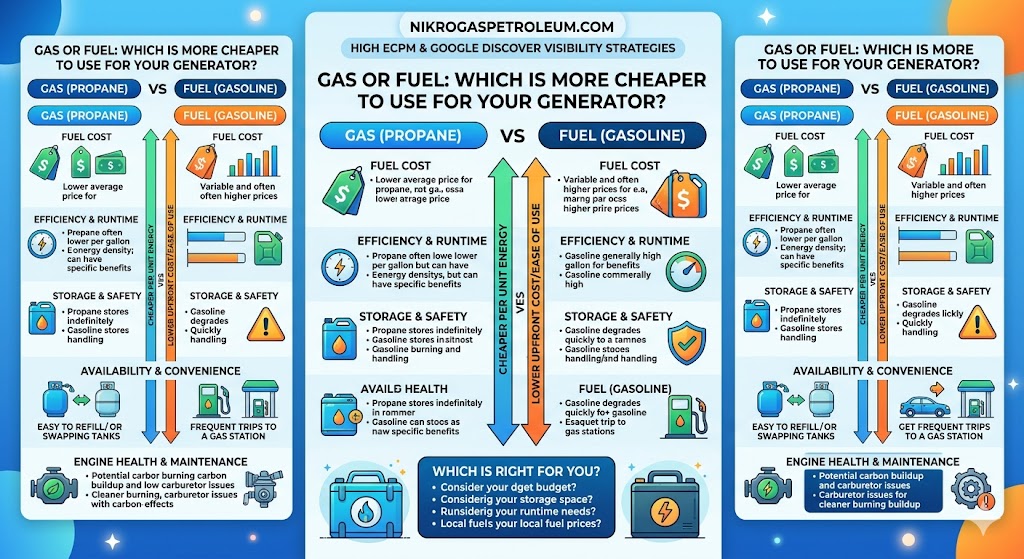
A standard 2.5kVA generator typically consumes about 1.2 liters of petrol per hour. At ₦1,350 per liter, your hourly running cost is ₦1,620. In contrast, that same generator converted to run on LPG consumes approximately 0.45kg of gas per hour. At ₦1,200 per kg, your hourly cost drops to ₦540. This means using gas is roughly three times cheaper than using petrol, despite the high cost of gas per kilogram.
Monthly Running Cost Comparison (6 Hours Daily)
| Cost Factor | Petrol (Fuel) | Cooking Gas (LPG) |
| Unit Price | ₦1,350 / Liter | ₦1,200 / Kilogram |
| Hourly Consumption | 1.2 Liters | 0.45 Kilograms |
| Cost Per Hour | ₦1,620 | ₦540 |
| Daily Cost (6 hrs) | ₦9,720 | ₦3,240 |
| Monthly Cost | ₦291,600 | ₦97,200 |
| Estimated Savings | N/A | ₦194,400 (66%) |
Efficiency and Engine Longevity
One “hidden” factor in this comparison is the maintenance cost. Petrol is a liquid fuel that often leaves carbon deposits on the spark plugs and inside the combustion chamber, especially with the fuel quality variations sometimes found in the market. This soot reduces engine efficiency over time.
Gas, however, is a cleaner-burning fuel. It leaves almost no residue, meaning your engine oil stays cleaner for a longer period. Users who have made the switch to the ₦1,200 gas model report that they can extend their service intervals, saving an additional ₦15,000 to ₦25,000 quarterly on oil changes and spark plug replacements.
Types of Gas Conversion Methods
If you decide to move away from the ₦1,350 petrol price, you need to understand the hardware required for the transition.
Dual-Fuel Carburetor Conversion
This is the most popular method in 2026. You replace the factory-fitted petrol carburetor with a hybrid version that has a gas inlet. This gives you the flexibility to use petrol if you run out of gas, or vice versa. These kits are currently priced between ₦25,000 and ₦40,000 depending on the generator’s capacity.
Dedicated Gas Generators
These are units built specifically for gas. They are highly optimized for gas pressure and often come with advanced safety features like automatic shut-off valves. While the initial purchase price is higher than a petrol generator, the long-term savings on the ₦540 per hour running cost makes them a favorite for businesses.
How to Apply a Gas Conversion to Your Generator
Making the switch requires a professional approach to ensure that your investment is safe and durable.
Purchase a Certified Kit
With the high demand for alternatives to ₦1,350 petrol, the market has seen an influx of substandard conversion kits. Ensure you buy a kit with a high-pressure regulator. A poor kit can cause the engine to “hunt” (unstable RPM), which can damage sensitive electronics like laptops or television sets.
Professional Calibration
Applying the kit is one thing; calibrating the “gas to air” ratio is another. If the mixture is too rich, you will waste your ₦1,200 per kg gas. If it is too lean, the engine will run too hot and could damage the valves. A trained technician should use a load test to ensure the generator runs smoothly at peak capacity.
Safety Placement Protocol
Always keep the gas cylinder outside. While gas is safer in terms of “spill fires,” a leak in a confined space is dangerous. Use a reinforced gas hose and keep the cylinder at least 3 meters away from the generator’s exhaust.
Frequently Asked Questions (FAQ)
Is it safe to use ₦1,200 cooking gas for my generator?
Yes, it is safe if the installation is done correctly. LPG is a stable fuel. You must ensure all connections are tight and use a soapy water test to check for bubbles (leaks) at the joints every time you refill your cylinder.
Does the generator lose power on gas?
There is a minor power drop, usually around 5% to 10%. If your generator carries a 1.5HP air conditioner comfortably on petrol, it will still carry it on gas, but you might notice a slight “strain” if you add too many other heavy appliances at the same time.
Why is gas cheaper if the price is ₦1,200 and fuel is ₦1,350?
The secret is in the mass. One liter of petrol is consumed much faster than one kilogram of gas because of the way the carburetor atomizes the fuel. You get much more “runtime” per kilogram than you do per liter.
Can I use the same gas for my generator and my kitchen?
Yes, the LPG used for cooking is exactly the same as the one used for the generator. However, for better budgeting, it is advisable to have a separate 12.5kg or 25kg cylinder dedicated to the generator.
Also Read: Why Gas Prices Keep Fluctuating Yearly
Also Read: Common Mistakes People Make at Gas Stations
Also Read: Are Electric Vehicles Killing Gas Stations
Conclusion
The numbers for 2026 speak for themselves. With petrol at ₦1,350 per liter and gas at ₦1,200 per kg, the cost of running a generator on petrol has become nearly triple the cost of gas. By switching to gas, a typical household can save nearly ₦200,000 every month. While the initial conversion cost is an investment, it pays for itself in less than two weeks of regular use.
In this era of high energy prices, moving to gas is not just an alternative it is the most logical financial decision for any Nigerian looking to keep their lights on without draining their bank account. Staying informed and applying these cost-saving measures is the best way to thrive in today’s economy.