What Really Happens Behind the Scenes at a Gas Station
Most people see a gas station as a simple point of transaction you swipe a card, pump the fuel, and leave. However, beneath the concrete forecourt lies a sophisticated network of engineering, logistics, and digital monitoring. As of April 2026, with the price of petrol in Nigeria at ₦1,200 per liter, the “behind the scenes” operations have become more high-stakes than ever. Every drop must be accounted for, and every safety protocol must be followed to ensure the business remains profitable and the environment remains protected.
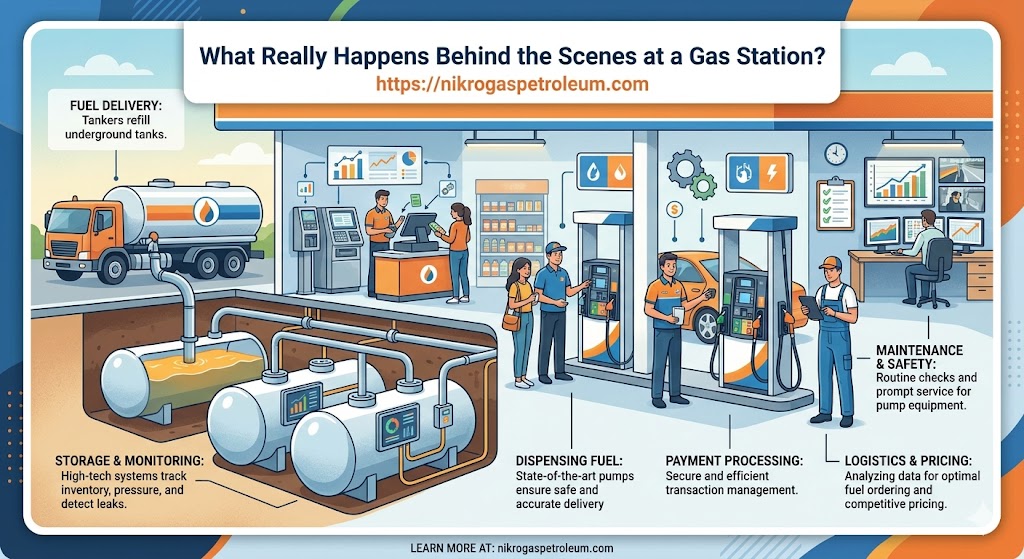
Behind the bright lights of the canopy is a complex ecosystem involving massive underground storage tanks, high-precision turbine pumps, and real-time inventory reconciliation software.
For a station manager, the day does not start at the pump; it starts in the back office, analyzing the “wetstock” data from the previous night. In this high-value energy market, the difference between profit and loss often comes down to managing the “invisible” parts of the station that the average customer never sees.
What Really Happens Behind the Scenes at a Gas Station
The Underground Infrastructure: Where the Fuel Lives
The most critical part of a gas station is entirely invisible to the public. Beneath your tires are several massive tanks, typically made of double walled fiberglass or protected steel, each holding between 30,000 and 60,000 liters of fuel. These tanks are equipped with “Automatic Tank Gauges” (ATG) highly sensitive probes that measure the fuel level, temperature, and even the presence of water at the bottom of the tank to within a fraction of a millimeter.
When you lift the nozzle at the pump, you aren’t just opening a tap. You are sending a signal to a “Submersible Turbine Pump” (STP) located inside the underground tank. This pump creates the pressure needed to push the fuel through a series of underground pipes, through a leak detector, and finally up into the dispenser.
This pressurized system is designed to shut down instantly if it detects even a minor drop in pressure, preventing thousands of liters from leaking into the soil.
Behind the Scenes: Operations vs. Reality
| Operational Component | What You See | What Really Happens |
| The Pump Nozzle | A simple metal handle | A dual-path valve that recovers vapors while dispensing |
| Fuel Delivery | A large truck parked nearby | A complex gravity-fed drop involving 35,000+ liters |
| The “Click” | The tank is full | A Venturi effect vacuum shut-off triggered by air pressure |
| Inventory Tracking | Numbers on a screen | Real-time reconciliation of sales vs. actual tank volume |
| Safety Systems | Red emergency buttons | Underground “Petro-interceptors” filtering all runoff water |
The Logistics of the “Fuel Drop”
One of the most intense moments behind the scenes is the arrival of a fuel tanker. In April 2026, a single tanker carrying 45,000 liters of petrol represents an inventory value of over ₦54 million. The “drop” process is a high-security operation. Before the first liter is unloaded, the station manager must verify the “ullage” (available space) in the underground tanks to ensure no overfill occurs. The driver then connects a heavy-duty hose to the fill pipe, often using a “vapor recovery” line that pulls harmful fumes out of the underground tank and back into the truck, preventing them from entering the atmosphere.
Vapor Recovery and Environmental Shielding
Modern gas stations are equipped with “Stage II Vapor Recovery” systems. While you are pumping ₦1,200 petrol into your car, the nozzle is simultaneously sucking the gasoline vapors out of your car’s tank and sending them back underground. This is why you rarely smell strong gasoline fumes at newer stations. Furthermore, the entire forecourt is designed with a slight slope leading to “interceptor” drains. If there is a spill or even just oil-stained rainwater, these drains catch the liquid and separate the hydrocarbons from the water, ensuring that only clean water enters the city’s drainage system.
The Economics: The Convenience Store Secret
It is a well-kept industry secret that most gas stations make very little profit from the fuel itself. After paying for the crude oil costs, transportation, taxes, and electricity to run the pumps, the profit margin on a liter of petrol is often less than 2%. So, how do they survive?
The C-Store Profit Engine
The “Convenience Store” (C-Store) is the real money-maker. While fuel brings the traffic, the snacks, coffee, and automotive fluids provide the profit. In 2026, data shows that a customer who buys a ₦2,000 bottle of water provides more net profit to the station owner than a customer who buys 30 liters of petrol. This is why stations are designed to force you to walk past rows of snacks and drinks to pay your bill.
Loyalty and Digital Tracking
Behind the scenes, the station is also a data hub. Every time you use a loyalty card or a mobile app to pay for your ₦1,200 fuel, the station is tracking your habits. They know if you prefer a specific brand of soda or if you only visit on Tuesday mornings. This data is used to adjust the “dynamic pricing” in the store and to send you targeted notifications to bring you back to the forecourt.
Security: More Than Just Cameras
Security at a modern gas station goes far beyond the visible CCTV cameras on the canopy.
Anti-Skimming and Payment Security
Inside each pump is a sophisticated computer that is constantly checking for “skimmers”—illegal devices designed to steal your credit card information. If the dispenser door is opened without an authorized technician’s code, the entire pump will automatically “brick” itself and send an alert to the manager’s phone. In 2026, most stations have moved to end-to-end encryption for all transactions at the pump to protect customers.
Remote Monitoring and Panic Alarms
In the back office, the manager has access to a “panic system” that can instantly cut all power to the pumps and lock the store doors in the event of an emergency. Many stations are now connected to “Remote Operations Centers” where off-site security professionals monitor the forecourt 24/7. These centers use AI to detect “irregular behavior,” such as someone loitering near the fuel tanks or a vehicle parked for too long in a restricted zone.
Frequently Asked Questions (FAQ)
Does the gas station “water down” the fuel?
In 2026, this is nearly impossible at reputable stations. The Automatic Tank Gauges (ATG) are so sensitive that they can detect even a small amount of water at the bottom of the tank. If the water level rises above a certain point, the submersible pump will automatically shut off to prevent water from being sucked into the lines.
Why do some pumps run so slowly?
This usually happens because the filters inside the dispenser are getting clogged with sediment from the underground tanks. Behind the scenes, the manager must change these “spin-on” filters regularly. If a pump is slow, it’s a sign that the station is due for a filter change or that the tank levels are dangerously low.
How often are the underground tanks inspected?
Regulations in 2026 require stations to perform “Precision Tightness Testing” annually. This involves using specialized equipment to ensure there are no microscopic leaks in the tanks or pipes. Additionally, the ATG system performs a “Static Leak Test” every night when the station is quiet and the fuel is still.
Why are gas stations often built on corners?
This is a strategic choice for logistics and traffic flow. A corner location allows for multiple entrance and exit points, which is essential for the large 45,000 liter tankers to maneuver safely. It also ensures maximum visibility for drivers from two different directions.
Also Read: Why Gas Prices Keep Fluctuating Yearly
Also Read: Why Some Gas Stations Suddenly Close Without Notice
Also Read: Common Mistakes People Make at Gas Stations
Also Read: Are Electric Vehicles Killing Gas Stations
Conclusion
The next time you pull up to a station to buy ₦1,200 petrol, take a moment to consider the invisible machinery working beneath your feet. Behind the scenes, a gas station is a high-tech facility that balances extreme environmental risks with thin financial margins. From the double walled fiberglass tanks to the AI driven security systems and the carefully curated convenience store shelves, every element is designed for maximum efficiency.
Understanding this complex operation helps us appreciate the engineering that keeps our modern world moving, one liter at a time. The station of 2026 is no longer just a “filling point”. it is a masterclass in logistics, safety, and retail psychology.